Journal: Saturday 19 November 2005
Amid a great deal of excitement we were all up with the larks this morning (are there larks in Egypt?) to join the early convoy to Abydos. Several of our group have never been there before and they couldn’t wait to see the Temple of Seti I at last. We were travelling in the minibus with yet another Abdul as our driver, as well as ‘our’ Abdul – this trip could get confusing. For the first time, we were permitted to drive straight to Abydos instead of turning off with the convoy to Dendera Temple and we arrived at the little village of el-’Araba el-Madfouna around 10.30am, finding to our joy that we were the only tourists there. Abdul had been in touch with his contacts at Abydos to ask if we could visit the desert sites, though none of us were holding out much hope because they have generally been off-limits for several years.

I love the first view of the temple when driving into Abydos. It stands proudly and sedately at the end of the road, just beyond a little garden area where cold drinks and relatively modern toilets can be found. We all made straight for the temple while Abdul went off to find his contact. I never tire of this Seti Temple with its magnificent reliefs, although today it had to be a swift look around because we knew that we would be coming back this way in a few days. To our great surprise the antiquities inspector gave his permission to visit some of the outer sites, though not the tombs this time as the excavation teams were working there at present. We got back into the minibus and headed north west out into the desert landscape in the company of the inspector and a police escort.

I find this area of Abydos very exciting, invoking thoughts of Egypt’s earliest kings and most ancient artefacts. It is a pilgrimage for me, a pilgrimage which has been happening for 5000 years or so. Since King Djoser built the first pyramid, ancient Egyptians flocked to Abydos, believing it to be the burial place of Osiris and turning it into an ancient ‘Mecca’. An annual re-enactment of the Osiris myth took place here for kings and commoners alike and if an Egyptian couldn’t make the journey in his lifetime, the ‘Abydos Pilgrimage’ was painted on his tomb walls, a symbolic journey to this sacred place. The pilgrims brought offerings of wine and incense in red clay pots which they smashed and millions of fragments can still be seen on the sandy slopes of Umm el-Gab. Many archaeologists have been attracted by the remains at Abydos but it is only since the 1960s that many new elements of the site’s long history have been found by the use of modern technology, slowly emerging like lost pieces of an ancient jigsaw puzzle.
We drove past Petrie’s evocative old dig-house on the way out into the desert. When he excavated here in the early 20th century, Shunet el-Zebib was the only large standing funerary enclosure – believed to be the oldest surviving brick building in the world. At that time Shunet was interpreted as a fort but it has since become clear that it the massive enclosure walls had a religious significance, a funerary complex built by King Khasekhemwy a generation before Djoser. It is now thought to be a ‘prototype’ for the first pyramid and has many similar elements such as massive niched enclosure walls, separate chapels and an inner pyramid-like mound.
Standing before the huge enclosure of Shunet el-Zebib and looking up at the 130m long, thick layers of sun-baked mud brick walls, I couldn’t help feeling a sense of awe at this ambitious construction which encloses an area of around one hectare. Inside, lying on the yellow sand there are still many potsherds from red clay vessels which contained the ibis burials from a later re-use of the monument. But the most exciting aspect of being here was to stand at the edge of the area where, since 1987, David O’Connor and the Abydos Expedition has unearthed a total of 14 brick-lined boat pits containing the remains of well-crafted and fully functioning wooden boats. Perhaps not as well-preserved as the famous solar boat at Giza, but certainly predating it, these proved to be the world’s oldest surviving boats built of planks, as opposed to those made of reeds or hollowed-out logs. Of course there was nothing to see except a slight depression in the sand because the boat-pits are once more covered up, but I have a good imagination.

We wrenched ourselves away from Shunet el-Zebib after a while to cross the dunes to a mysterious enclosure known as Kom es-Sultan, another impressive mudbrick structure to the east of Shunet. Kom es-Sultan represents part of the ancient city of Abydos, an area made up of complex layers of material, originally a tell which has long been destroyed by sebbakh (organic fertilizer) digging. It is assumed that the town surrounds the site of the earliest Temple of Osiris (or Khenty-Amentiu) in Abydos. Little is known about this structure itself, but the only known statue thought to be Khufu, builder of the Great Pyramid at Giza was found here.

A good part of the huge middle Kingdom mudbrick walls are still standing but only a few blocks now remain to give us a glimpse of the temples and structures they once contained. Huge numbers of stelae have been plundered or excavated in the past from this area which have provided a great deal of information on the cult of Osiris. More recent excavators have found substantial remains of residential streets of houses, as well as a larger domestic building or ‘mansion’ and many of the local industries are represented by evidence found there. The valuable information that has come from Kom es-Sultan has gone a long way towards piecing together the history of the isolated artefacts found at Abydos over the past century, allowing archaeologists to re-evaluate their context. Today the modern village of el-Khirba partly covers the area of Kom es-Sultan, but adjoining the enclosure is a recently excavated portal temple, built by Rameses II. To this day a wide beaten path through the desert leads from Kom es-Sultan to Umm el-Qa’ab, indicating the route of pilgrims over the millennia.
Our route was back to the village and the Seti Temple, where we went into the garden for a cup of coffee. A stall with souvenirs was manned by a young man, perhaps a descendent of one of those vendors of votive pots, incense and statues sold as offerings to ancient Egyptians on their pilgrimage in years gone by. It was here we learned that we had permission to visit Beit Khallaf.

Mastaba K1 at Beit Khallaf is situated to the north of Abydos and just to the south of Sohag near the village of Mahansa. The huge mudbrick monument is just as impressive as those at Abydos, but because of its remote location few people ever see it. This is an area investigated by John Garstang in the early 20th century and for many years there has been debate about the mastaba’s owner. There are actually five of these monumental stepped tombs in the low desert here dated to the early dynastic period, but K1 is the largest and best preserved. Several artifacts naming the Dynasty III King Netjerikhet (Djoser) were found in mastaba K1, along with numerous seal impressions, one naming a Queen Nimaathap as ‘Mother of the King’s Children’, while impressions bearing the name of Netjerikhet were also found in the other mastabas. Current archaeological evidence suggests Netjerikhet was the son and successor to Khasekhemwy, and probably performed his burial. Nimaathap was possibly related to Netjeriket in some way and may even have been his mother. The quantity of stone vessels found in the Step Pyramid and Nimaathap’s mastaba also contained identical ink drawings of the god Min, suggesting that they came from the same ‘heirloom’ collection.
Our police escort patiently waited at the foot of the mastaba while we thoroughly investigated its walls and climbed up to the top to look into deep shafts left by early excavators. There are several breaches of the walls where robbers have dug into the sides and top of the monument, but whether they found anything of note I don’t know. Today there are no inscriptions or decoration to excite the average tourist, but for me it is much more interesting than a pyramid because of its antiquity and it has captured my imagination with its history since I first saw it on a previous visit a few years ago. Are these mastabas the missing link between Khasekhemwy’s funerary enclosure and the first Pyramid at Saqqara?

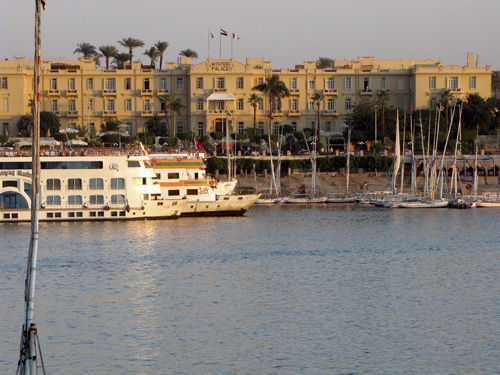
With a lot of thought-provoking discussion we carried on our journey in the minibus the short distance towards Sohag, where we booked into the Hotel Safa, which Sam and I had stayed in last year. At around 7.00pm I went out onto our balcony overlooking the River Nile, just in time to see a huge full moon rising over the eastern hills behind the town.
After lunch I went for a walk with Malcolm and Fiona. There have been a lot of changes here in recent years and many parts of the town are being smartened up. I was glad to see that the old suq was still there, although the first part of it has a new cobbled pavement and many of the stalls have been painted or rebuilt. There is even a new grand arched entrance! This is the area that attracts tourists, though they don’t often venture very far up the long street. Further along the pavement disappears and the road once more becomes a rough dirt track, littered with dubious puddles and donkey droppings. This is where the locals shop. I love this part of the suq as there is so much to see. Stalls selling bright gaudy fabrics mingle with shops selling spices of every variety. Next there may be aluminium pots and pans for any occasion, or plastic laundry baskets hanging in rows from long nails. Vendors of Galabeyas, shoes, taped Egyptian music and coffee shops line up along the street and they are all busy with their daily trade.

To the left and right sides of the road just north of the Ramesseum, is the site of a Temple of Tuthmose III, where at least we could see some evidence of a monument. The modern road now cuts right through this temple and on the left are substantial remains of a mudbrick pylon, while on rising ground to the right the site is marked out by aligned blocks, one or two with some nice reliefs and we saw a couple of column bases and fragments of painted fluted columns. The temple’s ancient name was ‘Henket-ankh’, and it was probably begun in the earlier part of Tuthmose’s co-regency with Hatshepsut. Many of the blocks and objects from here have found their way into museums around the world. Another destroyed temple is situated to the south of the Tuthmose temple, jointly belonging to Kings Merenptah and Siptah of Dynasty XIX. This is now a low mound at the side of the road, with no suggestion of the ruins it possibly covers. It was excavated by Petrie who found foundation deposits naming King Siptah and Chancellor Bay, as well as plaques, jar-sealings and fragments of vessels.
Across the road we had a wonderful view of el-Qurn, the pyramid-shaped mountain peak in which the ancient Egyptians believed that Hathor, the ‘Lady of the West’ resided. At the foot of the Theban mountain between Deir el-Bahri and Deir el-Medina, behind the village of Sheikh ‘Abd el-Qurna, is one of the oldest of the Theban temples, belonging to Mentuhotep Sankhare or Amenemhat I. It is thought that the structure was never completed and the temple consists today of only a platform and causeway, though very difficult to find. Because Sam and I had looked for it before, we didn’t bother today and carried on walking along the main road. Just to the south of the Ramesseum was a tiny temple in the name of Prince Wadjmose, a son of Tuthmose I. The temple is now completely destroyed, but statue fragments bearing the names of Wadjmose and Tuthmose I were found here as well as various blocks of Tuthmose III and several stelae. The next sites we came to were a destroyed temple of Tuthmose IV, and close by, a temple built for Queen Tawosret, wife of Seti II. This she shared with her successor Siptah. Little is known about this monument but there has obviously been some recent restoration done here.
The café at Medinet Habu was crowded with lunch-time coach tours, most of the long wooden tables were taken by Japanese tourists eating packed lunches provided by their hotels. We managed to find a free table at the edge of the café and gratefully sat down for a rest and a lengthy lunch consisting of lovely Egyptian salads and yummy garlic bread, washed down with deliciously refreshing lemon juice.
Feeling a little more lively as the mid-day heat began to abate we eventually walked across the road and into the Temple of Rameses III. Now this is what I call a temple – it has long been one of my favourite monuments in the whole of Egypt and it always feels like an old dear friend. Fortunately we had come inside during a lull which often happens in the early afternoon and the temple was very quiet. We each set off in different directions, which meant that the couple of guards on duty quickly gave up trying to follow us and went off for their siesta. The small temple, the oldest building at Habu constructed by Hatshepsut was closed due to the ongoing work by Chicago House. I headed off towards the shrines of the God’s Wives. Only two of the original four chapels still remain, but on a lintel above a doorway there is an ‘appeal to the living’, in which the Divine Adoratrice Shepenwepet II asks that a prayer be said for the occupants of the chapels. The request concludes in a threat – that ‘as for those who do not utter these words, the Mistress of the West will cause them to be sick and their wives to be afflicted!‘ So I like to say a little silent prayer as I pass by, just in case.


We began with the Tomb of Paheri (EK3). Paheri was a Mayor of the town of Nekheb during Dynasty XVIII. The paintings in his tomb are beautifully preserved with a lot of remaining colour and show many scenes of offerings at his funeral procession as well as agricultural scenes of daily life. In a niche in the rear wall is a statue of Paheri with his wife and mother. The next tomb was that of Tomb of Setau (EK4). Setau was a priest in the service of Nekhbet during the reign of Rameses III. On the outside wall of his tomb is a stela showing Setau and his wife adoring Re-Horakhty and Khepri. The paintings inside show the tomb-owner with his relatives in various offering scenes and a depiction of the Barque of Nekhbet with jubilee texts of Rameses III on the west wall. The reliefs are not quite so well-preserved as in the previous tomb, but there is still some lovely colour.
A tomb I especially wanted to see was that of Ahmose, son of Ibana (EK5). I had done some work a few years ago on translating parts of his famous biographical text from the hieroglyphs and I was so grateful to be able to photograph the original texts. In his biography Ahmose is described as ‘Captain of Sailors’ and he was prominent in the wars of liberation against the Hyksos rulers when the southern princes laid siege to the town of Avaris in the Delta. The text tells of the favours Ahmose was granted for his part, including the award of the ‘gold of honour’ and tells that he was given four slaves by His Majesty from the booty he carried off. He was the Grandfather of Paheri (EK3) who is seen offering to him in the tomb. The next tomb of belongs to Renni (EK7), a mayor of Nekheb during the reign of Amenhotep I. Renni’s tomb depicts the usual agricultural scenes, banquet scenes and funeral procession. The detail and the colour in these reliefs is superb and there are some very unusual cameos such as ‘muu’ dancers in the funeral precession, the opening of the Mouth Ceremony and a ‘tekenu’, that mysterious object pulled on a sledge that is occasionally glimpsed in a funeral procession. I have long been fascinated by the tekenu. There is a niche in the rear wall of Renni’s tomb which contains the remains of a statue of the tomb-owner flanked by two jackals. One of the most beautiful aspects of all these tombs is the painted ceilings and in Renni’s tomb the ceiling is painted to represent the cloth roof of a tent or canopy.

the oldest of the remains, with its origins possibly dating to the Early Dynastic Period. Of the two ruined structures remaining today, the Temple of Thoth was begun by Amenhotep II in Dynasty XVIII and enlarged by later New Kingdom pharaohs. Another monument, a larger Temple of Nekhbet the vulture goddess, was built during the Late Period and partly overlays the older structure with many re-used blocks from the Middle and New Kingdom. It was difficult to make out the plan of monuments within the town site as the inside is very overgrown and confusing, but the remains of a birth-house and a small Roman temple can still be seen. One feature which captured the interest of the men in our group (always more interested in technical matters) is the complex drainage system which is exposed in front of the second pylon of the Nekhbet Temple. I was captivated by the reliefs of the re-used blocks in the ruins, some of them upside-down or wedged sideways into a space and once or twice we came upon lovely little statues which felt forlorn and neglected.
Further along the valley road is ‘Vulture Rock’, so-called because its shape seen at a certain angle (which in my opinion needs a great deal of imagination) is said to resemble the shape of a vulture. Or maybe it is where vultures, probably prolific in the cliffs of this remote spot, go to roost. The southern face of the rock is covered with petroglyphs and Old Kingdom inscriptions probably made by pilgrims passing this way on the ancient desert road towards the Red Sea coast. Several Old Kingdom kings are named on smooth panels cut into the rock, the earliest cartouche is that of Snefru. There are also Late Period primitive rock-carvings including many boats. We scrambled around the rock for a while before moving on further into the desert.
At the end of the track is a lovely little temple dedicated to Hathor and Nekhbet, built by Tuthmose IV and Amenhotep III. The single chamber was apparently a way-station for the barque of Nekhbet when the statue of the goddess was brought to her desert valley. Quite a lot of colour still remains on the wall reliefs inside the temple, depicting Tuthmose IV and his son Amenhotep III. The building was restored in late antiquity and brightly painted scenes of rituals as well as the vulture goddess still can be seen. On the chapel façade is a text by Prince Khaemwaset, the son of Rameses II, announcing his father’s jubilee in year 42, as well as graffiti by other passing travellers including more primitive boats.


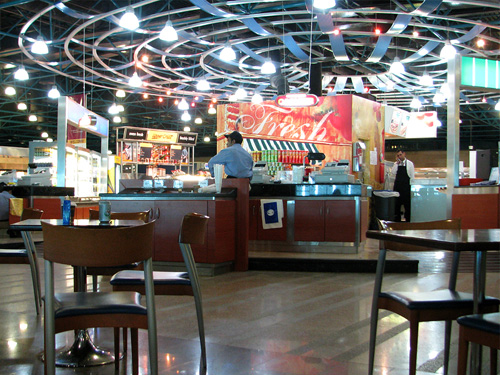
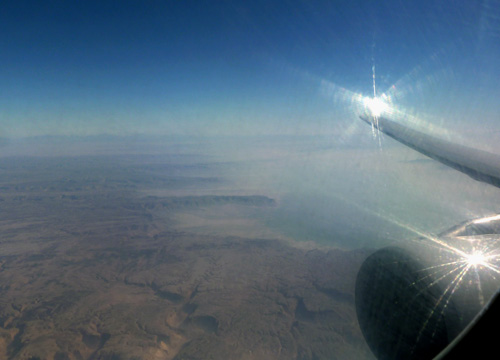
Sam and I were up at 5.00am. Abdul had arranged to take us to the airport at 7.00am but it was actually nearer 7.45am by the time we left, which just reminded me that Egyptians have no concept of being on time. When we got to the airport, there was a big queue of locals for the Cairo flight, but Abdul managed to persuade the police to let us go to the front of the queue as we were late. We checked in our luggage and they grumbled about the weight but let us through as we were the last to check in – the flight was due to leave at 9.00am. We hurried up to the cafeteria, only to be confronted by another big queue at the counter and there was not enough time for a last cup of coffee. At least we didn’t have long to wait and soon almost everyone else had boarded the busses so we thought we’d better go too. We were both very subdued but I felt OK as we climbed the steps on to the plane, with a last look around before going inside. It wasn’t until we were taxiing up the runway that Sam & I dared to look at each other. My cold suddenly got particularly bad and Sam put on her sunglasses and hid her head under a blanket. After about an hour we could speak to each other for the first time today! I really hate this bit.


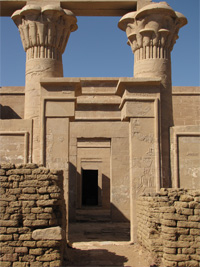
Our plan was to visit Hibis Temple and try to get into the hypostyle hall and sanctuary where there are some unique reliefs. The gafir however, told us that it is closed (always has been!) and he couldn’t let us in without permission from the antiquities inspector for Kharga. He wouldn’t take baksheesh and even Salah couldn’t charm him. So off we went back into town to see a lovely man called Mohammed Yusseff, a friend of Sam’s and the director of the Kharga Museum. He tried to get permission for us from the Inspector but couldn’t. He even phoned the SCA office in Cairo and spoke to the lady who issues our antiquities permissions and then Sam spoke to her too. I think Mr Yussef would even have phoned Zahi Hawass himself had he not been out of the country. He was really upset that he himself didn’t have the authority to give us permission to get into the temple. The Cairo office told us it would cost $1000 each to have sites specially opened for us under the new rules. We must have been just lucky up to now with closed sites. This is why the large specialist travel firms have to charge such vast sums for some of their holidays – because they have to buy permission for the sites that are closed. Anyway, we were rather disappointed and after a cup of coffee with Mohammed we left for the temple again.
I was also a bit disappointed to find that the whole temple was covered by scaffolding because of restoration work. There used to be a huge gate through the outer enclosure wall, quite famous for its Roman inscriptions and decrees covering all sorts of topics about Roman rule in the oasis. There has been a plan for the past 20 years to dismantle and move the temple, which has been falling down ever since it was built , and work began a couple of years ago. Rather than get the experts in, the government decided to go for an Egyptian construction contractor who quickly chopped the gate down to about the bottom two courses. In the process they have ruined it and it can never be rebuilt as it originally was. We first learned about this last year – it is not common knowledge outside of Kharga. Mohammed Yussef was talking to us at the Museum and he is livid about it and the fact that it is being kept quiet. It is so sad. The dismantling has thankfully now been halted again, but it is too late for the gate.


before it was no longer allowed. You can never tell, the way things are going. I think we photographed every scene in the temple. There are some beautiful and colourful depictions of the gods at Deir el-Medina and they are so well-preserved. Ptolemaic reliefs are not my strong suit and once more I was having difficulty in reading the hieroglyphs, which to me don’t seem to make sense. After leaving the temple we walked back along the top of the workman’s village. As usual here we were accosted by men selling ‘genuine antiquities’ which they bring out of pockets in little tobacco tins in a very secretive way. I managed to get rid of them quite quickly by speaking Arabic – they soon lost interest, realising we were not gullible tourists, this usually works. Every time I walk through the village there seems to be more and more of it – I’m sure it’s growing.